
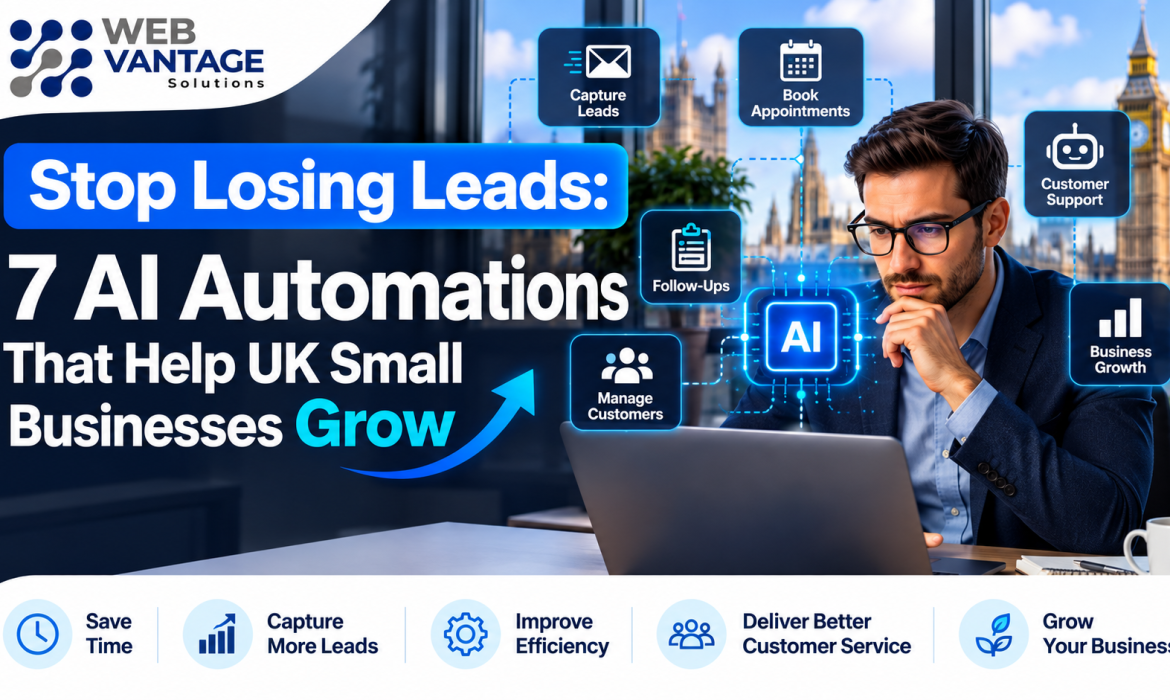
Running a small business in the UK means juggling multiple responsibilities. Between responding to customers, managing enquiries, organising appointments and delivering services, it is easy for important opportunities to slip through the cracks.
A potential customer submits an enquiry on Friday evening. Nobody replies until Monday. By then, they may already have contacted a competitor.
Another customer requests a quotation, but the follow-up gets forgotten. A third asks the same question your team has answered dozens of times.
These problems are common, but many can be reduced through practical automation.
AI automation for small businesses in the UK is not about replacing your entire team or investing in complicated technology. It is about using the right tools to handle repetitive work, improve response times and help your employees focus on valuable customer relationships.
Explore our AI Automation services for practical help with lead capture, follow-ups and connected business workflows.
Here are seven AI automations worth considering.
In this guide:
- 1. Instant Lead Capture and Response
- 2. Automated Sales Follow-Ups
- 3. Appointment Booking and Reminders
- 4. AI-Powered Customer Enquiry Triage
- 5. CRM and Sales Pipeline Automation
- 6. Automating Repetitive Administration
- 7. Automated Business Reporting and Insights
- How Much Does AI Automation Cost for a UK Small Business?
- Is AI Automation Safe for UK Businesses?
- Frequently Asked Questions
1. Instant Lead Capture and Response
Imagine a customer visiting your website outside office hours and submitting an enquiry.
Without automation, that message might sit in an inbox until someone checks it.
With an automated lead response system, your business can immediately acknowledge the enquiry, record the customer’s details and notify the appropriate team member.
A well-designed system can:
- Capture enquiries from website forms.
- Send immediate acknowledgement emails.
- Categorise enquiries by service or urgency.
- Notify your sales team.
- Record the enquiry in your customer relationship management (CRM) system.
Example: A Leeds-based plumbing company receives an emergency enquiry at 8 pm. An automated workflow acknowledges the request and alerts the on-call team, rather than waiting for someone to check the general inbox.
The result is a more consistent customer experience and fewer opportunities overlooked.
2. Automated Sales Follow-Ups
Not every customer makes a purchasing decision immediately.
Some need a quotation, internal approval or additional information. When your team is busy, it can be difficult to remember every follow-up.
Automation can help by scheduling reminders and sending appropriate messages at the right stages of the sales process.
For example, after a customer requests a quotation, your system could:
- Record when the quotation was sent.
- Remind your sales representative to follow up.
- Prepare a personalised follow-up email for approval.
- Stop the sequence when the customer responds.
- Flag interested customers for a phone call.
The key is to make communication helpful rather than repetitive.
A follow-up system should respect customer preferences and applicable UK privacy and electronic marketing rules.
Business benefit: Your sales team spends less time tracking conversations manually and more time speaking with potential customers.
3. Appointment Booking and Reminders
Businesses that rely on consultations, meetings or service appointments often lose time managing calendars.
AI-assisted booking workflows can help customers choose available appointment slots and receive confirmation without repeated emails.
A typical workflow could:
- Receive a consultation request.
- Check available appointment slots.
- Offer suitable times.
- Send a booking confirmation.
- Send a reminder before the appointment.
- Update the relevant calendar or CRM record.
This can be useful for consultants, accountants, agencies, property services and many other UK businesses.
Automated reminders may also reduce missed appointments, although results depend on the business and how the system is implemented.
Could your business benefit from automation?
If your team regularly handles enquiries, follow-ups or appointment scheduling manually, there may be opportunities to simplify those processes.
Request a Free AI Automation Opportunity Review from Web Vantage Solutions.
We can help you identify repetitive workflows and explore practical automation options for your business.
4. AI-Powered Customer Enquiry Triage
Customer support teams often receive similar questions:
- What are your opening hours?
- How much does your service cost?
- Can I change my appointment?
- How do I request a quotation?
- When will someone contact me?
An AI-assisted enquiry system can identify the type of question, provide approved information and direct more complicated requests to a human.
For example, a professional services business could use an automated assistant to explain its consultation process and collect initial enquiry details.
However, an AI assistant should not invent prices, promise services that are unavailable or provide unreliable advice.
A good implementation uses verified business information, clear escalation rules and human oversight.
Business benefit: Customers can receive useful information more quickly, while staff remain available for conversations requiring judgement.
5. CRM and Sales Pipeline Automation
When customer information is spread across emails, spreadsheets and notebooks, managing the sales process becomes difficult.
A CRM helps organise leads and customer interactions. Automation makes that system more useful by reducing repetitive data entry.
For example, when a new enquiry arrives, an automated workflow could:
- Create or update a CRM contact.
- Identify the service requested.
- Assign the lead to a team member.
- Create a follow-up task.
- Update the sales pipeline when the lead progresses.
- Notify the manager when an important opportunity needs attention.
This creates a clearer picture of which enquiries are new, which need follow-up and which have become customers.
For growing UK businesses, better pipeline visibility can be just as valuable as generating additional enquiries.
6. Automating Repetitive Administration
Many businesses spend significant time copying information between systems, organising documents and preparing routine updates.
Some of these tasks can be automated.
Examples include:
- Transferring approved form data into business software.
- Creating internal tasks from incoming requests.
- Organising documents by customer or project.
- Preparing draft reports.
- Extracting information from structured documents for review.
- Sending internal status notifications.
Not every administrative task needs AI. Simple rule-based automation is often more reliable and affordable.
AI becomes useful when a process involves interpreting messages, classifying information or working with less structured content.
The best approach is to choose the simplest technology that reliably solves the problem.
7. Automated Business Reporting and Insights
Business owners need to understand what is happening across their sales and operations.
But preparing reports manually can take time, especially when information comes from several different systems.
Automation can bring approved data together into dashboards or scheduled summaries.
A business might track:
- Website enquiries received.
- Enquiries by service category.
- Average first-response time.
- Follow-ups awaiting action.
- Sales opportunities created.
- Leads converted into paying customers.
AI can also help prepare plain-English summaries of trends for management review.
For example, a weekly report might highlight that enquiries increased while response times became slower.
That insight gives the business owner something specific to investigate.
Reporting should use accurate source data, and any AI-generated conclusions should be checked before important decisions are made.
How Much Does AI Automation Cost for a UK Small Business?
There is no single price for AI automation.
Costs depend on the complexity of your processes, the systems you already use and whether you need custom software development.
A straightforward workflow connecting a website form to an email notification may be relatively simple.
A more advanced solution involving several platforms, custom integrations, access controls and AI-assisted decisions requires additional design, testing and maintenance.
Before investing, consider three questions:
- What problem are we solving? Identify a specific repetitive task or missed business opportunity.
- How often does it happen? A task performed dozens of times a week may offer more value than one performed occasionally.
- How will we measure success? Possible measures include staff time saved, response time, data accuracy or completed follow-ups.
Start with one manageable workflow, test it and expand only when there is a clear business case.
Is AI Automation Safe for UK Businesses?
AI automation can be useful, but businesses must take security and data protection seriously.
Before connecting customer information to an AI service, consider:
- What personal data is being collected.
- Whether the business has an appropriate lawful basis for processing it.
- Which third-party providers receive the data.
- How long information is retained.
- Who can access customer records.
- Whether automated outputs require human approval.
- How errors and security incidents will be handled.
Data protection should be part of your planning. UK businesses should consider their obligations under the UK GDPR and Data Protection Act 2018, along with applicable electronic marketing rules.
Customer information should not be sent to an AI system simply because a technical integration makes it possible.
Good automation starts with appropriate permissions, data minimisation, secure integration and sensible oversight.
How to Get Started With AI Automation
You do not need to automate everything at once.
A practical starting point is to examine where your team loses time or where customers experience delays.
For many small businesses, the first opportunities are website enquiries, follow-ups, appointment booking and CRM updates.
Choose one workflow, document how it currently operates and decide what improvement you want to achieve.
Then test the proposed automation with realistic examples before making it part of everyday operations.
How Web Vantage Solutions Can Help
At Web Vantage Solutions, we help businesses explore digital solutions, custom software and automation opportunities.
Our approach begins with understanding your existing processes and identifying where technology could make a practical difference.
Whether you want to improve lead capture, connect business systems, streamline administration or explore AI-assisted workflows, the starting point is a clear understanding of your requirements.
Request Your Free AI Automation Opportunity Review
Are manual tasks slowing down your business? Are customer enquiries getting missed? Is your sales team spending too much time updating spreadsheets?
Discuss your workflow through our contact page and mention “AI Automation Opportunity Review” in your enquiry.
Contact Web Vantage Solutions to request your free AI Automation Opportunity Review. Tell us which manual task or missed enquiry you would like to address.
Frequently Asked Questions
What is AI automation for small businesses?
AI automation combines software workflows with artificial intelligence where useful. It can help businesses classify enquiries, prepare responses, organise information and support repetitive processes.
Can AI automation help generate more leads?
Automation does not automatically create demand for a business. However, it can improve how existing enquiries are captured, acknowledged and followed up, potentially helping a business convert more of the opportunities it already receives.
Do I need a large budget to start?
Not necessarily. Some workflows can use existing software and relatively simple integrations. More complex projects may require custom development and ongoing support.
Will AI automation replace my employees?
Not necessarily. Many small businesses use automation to support employees by reducing repetitive administration. Human involvement remains important for customer relationships, sensitive decisions and quality control.
How long does it take to implement AI automation?
Implementation time depends on the workflow, existing systems, data quality, security requirements and testing. A simple integration may be quicker than a custom solution involving multiple business platforms.
Is AI automation suitable for my industry?
Potentially. Professional services, retail, property businesses, trades, agencies and other organisations may benefit from well-chosen workflows. The right solution depends on the actual business process, not simply the industry.